
Nissan Plans 19 New EVs By 2030
For decades, Nissan has established a reputation for being at the forefront of automotive innovation. Recently, the automaker doubled down on its forward-thinking vision, pledging to introduce 27 new electrified vehicles —including 19 EVs—by 2030. Within that number are four additional EVs than the original number announced back in 2021 as part of the Nissan Ambition 2030 program. Here’s what we know so far about Nissan’s push toward an all-electric future.
Nissan Is Working Hard on High-Quality EV Batteries
Nissan’s commitment to produce 19 different EVs by the year 2030 is a goal that reflects incredible ambition, but it’s a goal that the automaker can achieve. Working with the University of Oxford, Nissan is developing solid-state batteries. By 2024, Nissan intends to open a production facility for these batteries, developing and refining the process to eventually become a solid-state battery production facility by 2026. The batteries produced at this facility are set to hit the road in Nissan’s fleet of vehicles by 2028.
What’s so great about solid-state batteries? They’re the gold standard of EV batteries, using a solid electrolyte rather than a liquid one. That means they’re more energy-dense and less temperature-sensitive, all while offering quicker charging times. If Nissan scales production correctly, solid-state batteries could soon be cheaper than the less-efficient current generation of batteries—lithium-ion packs.
Manufacturing is challenging when it comes to solid-state batteries. They use ceramic or glass electrolytes that can be very brittle, making cell assembly en mass very demanding. The electrolytes often break and must be thrown away—it’s a problem that has kept other EV companies like CATL and Tesla from embracing solid-state batteries. Nissan remains confident that—thanks to its partnership with the University of Oxford—it can produce solid-state batteries on a commercial scale in just a few years.
Solid-State Batteries Will Be a Game-Changer for EVs
How good will solid-state batteries actually be? In short, surprisingly good. While we don’t yet know the exact energy density or chemistry Nissan’s using for its batteries, what we do know is how fast the charging speed will be. Nissan has announced solid-state batteries can fast charge at a consistent 400 kW. To compare, the Tesla Model 3 LR only reaches a peak charging rate of 250 kW. This is peak charging, which means that if the battery is close to full or isn’t at an ideal temperature, charging will be much slower.
A 400-kW consistent charge means that a Nissan with the same-size battery as a Tesla can charge from 10% to 80% in less than 8 minutes. That’s an incredible feat that other automakers aren’t even close to matching.
In the meantime, Nissan is developing two new generations of lithium-ion batteries. The next generations will be cobalt-free, making them much better for the environment. It’s clear that the future is bright for Nissan’s EVs, and we have the automaker to thank for embracing an all-electric future.
An All-Electric Future Is Already Here
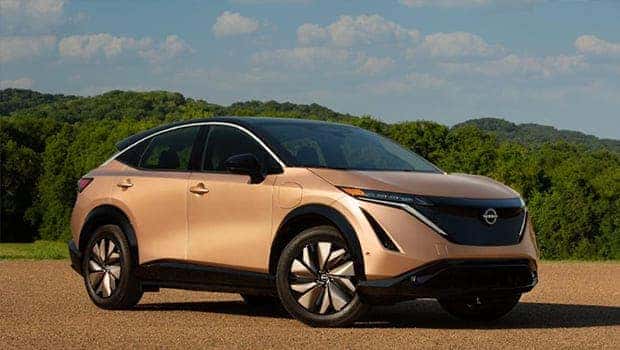
While Nissan’s EV innovations are set to expand greatly in the coming years, the automaker already has two exceptional EVs on the market—the Nissan Ariya and the Nissan Leaf. That means you don’t have to wait to make the switch to clean, gas-free transport. Stop by Maus Nissan of New Port Richey today or give us a call at 727-261-7598 to learn more!
0 comment(s) so far on Nissan Plans 19 New EVs By 2030